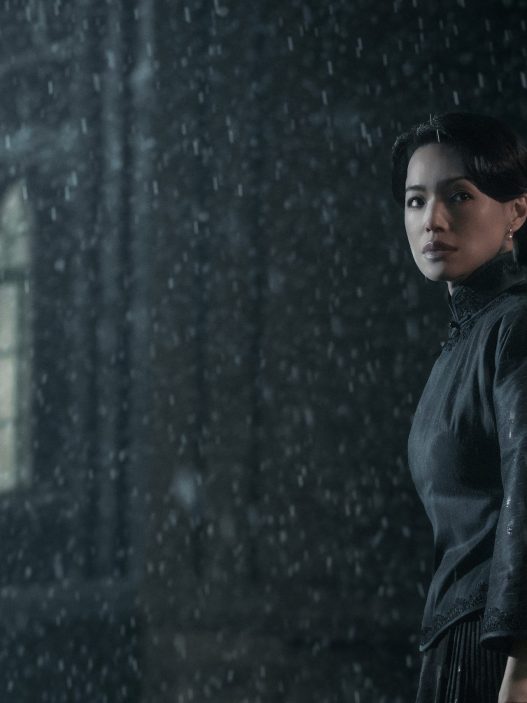




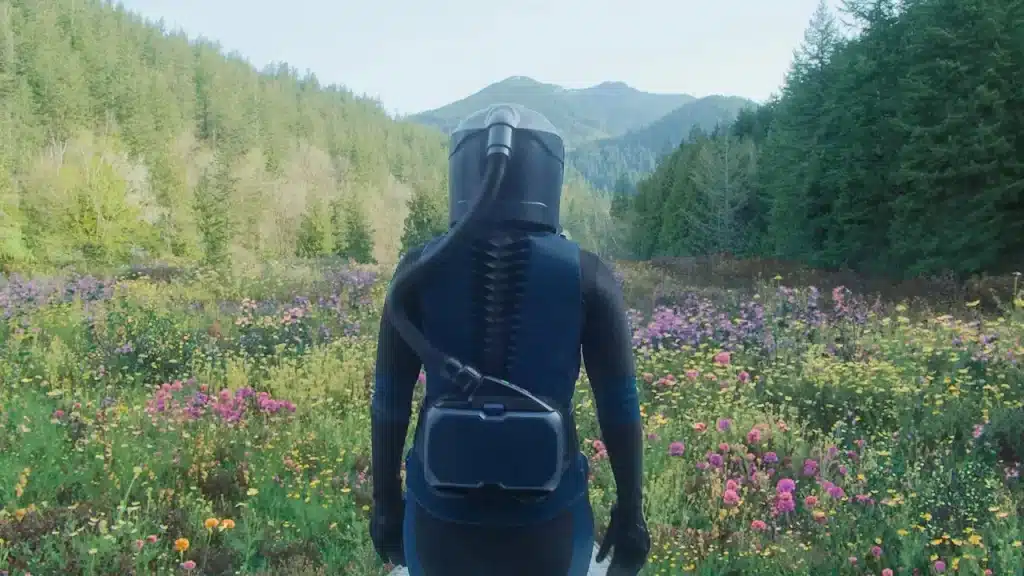
In the Blink of an Eye is an ambitious, sprawling drama that leaps across millennia to ask one deceptively simple question: what does it truly mean to be alive? The film weaves together multiple storylines from vastly different eras, including a prehistoric family navigating survival and love, and a modern-day pair finding each other in the middle of everyday chaos, to explore the enduring threads of human connection, sacrifice, and purpose. It is equal parts love story, philosophical meditation, and time-hopping adventure, all rolled into one.
Cast
If there is a heartbeat at the centre of this film, it belongs to Rashida Jones and Daveed Diggs. Their chemistry is the kind you cannot manufacture; natural, warm, and genuinely charming. Watching their relationship evolve from cautious glances to something deeper is the emotional engine that keeps the whole film running. Their witty banter crackles with the kind of ease that only comes from two performers who clearly understand each other’s rhythm. Jones brings quiet depth to every scene, while Diggs injects a playful energy that makes their dynamic irresistible. Together, they are the living, breathing reason this film works as well as it does.
The prehistoric storyline presents a different kind of performance challenge entirely, one largely without dialogue. Without subtitles to bridge the gap, the caveman sequences demand a lot from the audience early on. It takes patience to settle into the premise, but once you do, the emotional core of that story lands with surprising force. Credit to the performers for communicating grief, love, and longing through little more than expression and physicality. It is raw, primal filmmaking and ultimately, it earns its place.
Prodcution
Cinematographically, In the Blink of an Eye is genuinely striking. This is a unique work of modern cinematography; the camera work shifts its register across time periods with intention, moving from the textured, earthy tones of prehistoric sequences to crisper, more intimate framing in contemporary scenes. The visual language adapts to the era, which is a smart touch.
The soundtrack carries much of the emotional weight that dialogue cannot always reach, particularly in the wordless sequences. It is sweeping when it needs to be and restrained when the moment calls for silence, complementing the film’s thematic ambition without overpowering it.
Where the production stumbles is in its structural choices. The decision to mash all time periods together without screen labels or a clearer chapter format creates moments of genuine confusion. The non-linear, era-blending approach is a bold swing and it does connect in certain sequences. When multiple characters across different time periods are shown experiencing grief in parallel, back to back, the effect is genuinely moving. The shared humanity of loss becomes visceral and immediate. In those moments, the structure earns every bit of its ambition.
But those moments are not consistent. Without clear signposting, the jumps between eras can feel disorienting rather than profound, and a chapter-based format could have given the audience the grounding it needed to let the emotion land more freely.
Review
In the Blink of an Eye is the kind of film that has more ideas than it knows what to do with, and that is both its greatest strength and its most persistent flaw.
The concept is genuinely interesting: by placing wildly different generations of humanity side by side, the film invites us to reflect on what connects us across time. Are we living with purpose? Do we make time for the right people? Are we sacrificing the things that matter for things that do not? These are the questions the film presses its thumb against, and when it does, the message resonates. It does not lecture; it reflects, holding a mirror up with enough warmth that the discomfort feels like an invitation rather than a verdict.
The film shines brightest as a celebration of love and endurance. It is a positive, affirming piece of work that believes, quite sincerely, in the power of human connection to outlast time itself. That optimism is not naïve; it is earned, scene by scene, through the small moments that accumulate into something larger.
The trouble is that In the Blink of an Eye is carrying several films’ worth of themes on its back, and not all of them have room to breathe. Ideas around generational sacrifice, mortality, ambition, grief, and belonging are all introduced, but many are picked up and set back down before they fully develop.
And yet, for all its structural restlessness, the film’s heart is in entirely the right place. It is ambitious, visually arresting, emotionally genuine, and grounded by two lead performances that alone are worth the price of admission. If it occasionally trips over its own scope, it does so while reaching for something meaningful and that, at least, is worth celebrating.

Your go to for all things film, tv, gaming, pop culture! Can I be your movie guy?